
Close your eyes, and picture an outfit from the 1980s. Now, the 1990s. The 2000s. Chances are you thought of perms and shoulder pads first, then grungy flannels and preppy streetwear, before finally thinking of low-rise jeans and velour tracksuits.
But if I were to ask you to picture something from the 2010s, that answer might range anywhere from colored leggings to checkered Vans. That range gets even wider when we look at the 2020s so far.
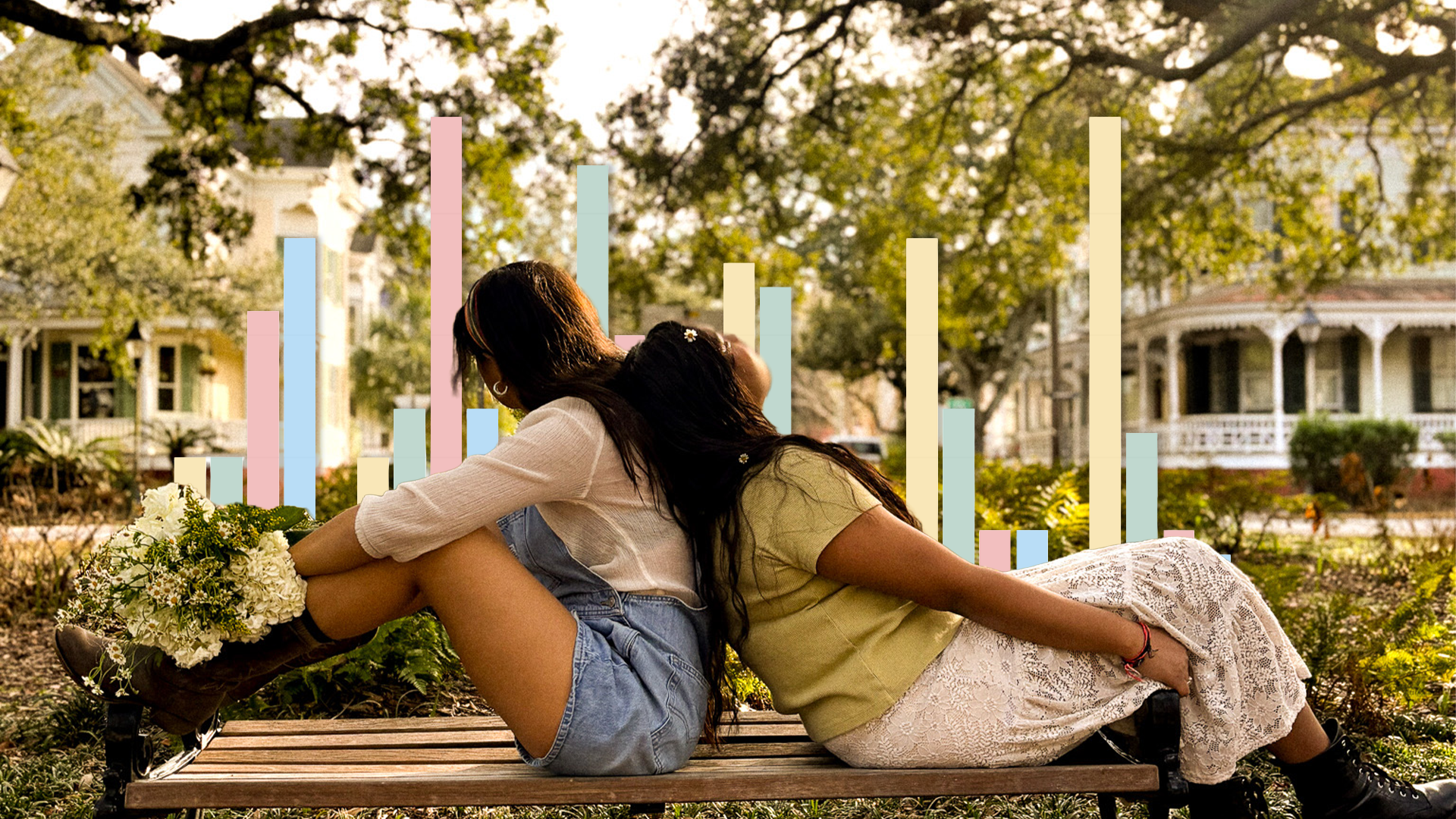
We used to have a very clear idea of which styles belong to which decade, but that distinction has gotten increasingly muddy in the last fifteen to twenty years. We’ve lost the pattern of an iconic style or two defining each decade, and it’s affected our favoritism when it comes to fashion. The 80s, 90s, and 2000s—decades with only a handful of predominant styles—rank highest when respondents are asked for their favorite fashion decade.
On average, 9.5% of respondents favored the 80s, 11.25% favored the 90s, and 8.25% favored the 2000s.
Even when we abandon the idea of “favorites,” those decades still rank the highest when respondents were asked how fashionable they found each decade. Repeatedly, the 2010s and 2020s rank lowest on average when it comes to being fashionable decades with a defined sense of style.
Fashion trends are increasingly speed-running their usual five stages: introduction, rise, peak, decline, and obsolescence. Instead of the usual fifteen to twenty year cycle, we’re now seeing trends rise and fall within a matter of months. What happened?
The Internet.
Internet usage has increased across all generations over the last 25 years, and with it, our access to fashion inspiration outside of current pop culture. Instead of fashion trends being born on a runway and trickling down through magazines, movies, and music videos to the general public, modern teenagers and young adults are finding their new favorite styles on their For You and Explore pages, with 42% of Gen Z listing social media as their main source of fashion inspiration.
While expressions of individuality and personality have always been a priority when it comes to fashion, younger generations now feel that burden more acutely due to their exposure to the world online. Pre-internet, you knew the people in your town, and you knew the familiar movie and music stars. It was normal for everyone to take fashion inspiration from the screen, like when Dirty Dancing had everyone in leotards, or when Top Gun boosted aviator jacket sales. In the digital era, you have access to the whole world.
That’s not an exaggeration, either. Out of the 8 billion people on Earth, more than 5.17 billion use social media and spend an average of over 2 hours scrolling every day. Instagram and TikTok are the top platforms for young adults, with 89% of Gen Z users on Instagram and 82% on TikTok.
Breaking those audiences down makes it even more jarring to realize how many people we’re seeing on our screens now. Instagram alone has 3 billion monthly active users, and nearly a third of them are 18-24 year olds. TikTok is no different, with a majority of its 1.9 billion monthly active users being Gen Z. Additionally, out of Pinterest’s 553 million monthly active users, 42% of them are Gen Z, often searching specifically for style inspiration.
With these sorts of numbers, it’s not outrageous to assume that a young adult in 2026 will see thousands of strangers online every day. More often than not, they’ll see these strangers jumping onto the same trends they are, but when the whole world is following the same trends, how is anyone meant to feel like an individual? How are the 71% of Gen Z’ers that prioritize personality in their style meant to feel like they’re unique?
It seems their answer is a wider range of hyper-specific aesthetic niches. Now, to a reader who isn’t chronically online, you might think the word aesthetic is an adjective describing something “concerned with beauty or the appreciation of beauty” or maybe a noun for “a set of principles underlying and guiding the work of a particular artist or artistic movement.” In the modern online fashion world, it means something a bit more distinct.
A clothing aesthetic in 2026 can be defined as, “your personal style or the overall vibe your outfits create. It’s the visual theme that ties your wardrobe together, from colors and patterns to the types of pieces you wear,” according to Copenhagen Fashion Summit. Included with the site’s definition are no less than 42 different aesthetics, such as Soft Girl, Clean Girl, Streetwear, Fairycore, Cottagecore, Witchcore, both Light and Dark Academia, and many others.


Cottagecore might be one of the most popular, emerging back in 2019, and is essentially a romanticization of rural life. Cottagecore styles include warm and earthy colors, flowy dresses, puffed sleeves, and cardigans, while activities include gardening, crocheting, and baking bread. Overall, it’s a cozy, peaceful aesthetic that prioritizes comfort. While the general trend might’ve died a few years ago, Cottagecore has quietly lived on past its hype like many of these aesthetics tend to do.
Since Cottagecore’s heyday, aesthetics have gotten even more specific. Depop, a popular clothing resale platform, posted their 2024 Trend Report, and the following ‘core’ styles had some of the highest search volume increases: “Contemporary classics,” “Minimalist renaissance,” “Retro sportswear,” and “Indie vanguard.”
Contemporary classics is defined as an “updated take on ‘old money’” in the report, reviving preppy styles by blending Ivy League style with countryside vibes. Brands like J.Crew and Ralph Lauren are named as the leaders here, with Depop saying the aesthetic “reflects a yearning for stability and reliability.”
The Minimalist renaissance is a return to “understated elegance,” according to Depop, and is focused on clean lines, neutral colors, and classics like cashmere and tailored coats. This aesthetic has a specific focus on craftsmanship and dedication to timeless taste.
Retro sportswear follows the more traditional trend pattern of recycling from decades prior, and pulls from 80s windbreakers and 90s athletic styles, combining them with modern flair for nostalgic yet practical outfits. This specific style’s increase could be attributed to the rise in popularity of casual sports like pickleball in recent years.
And finally, Indie vanguard is described as “bold reimagining of 2010s indie sleaze and hipster culture,” combining grunge and punk styles with the early 2000s. Think band tees paired with knee-high boots and boas. Even better, think Charli XCX’s style during her “Brat” era from the summer of 2024.
Now, is the rise of aesthetics a bad thing? In a general sense, I don’t think so, but there is an important caveat. Younger generations not having an agreed “uniform” of sorts in favor of having specific, sometimes eccentric wardrobes is completely fine. What we consider to be “normal” changes constantly, and what was normal for trends thirty years ago just isn’t normal anymore.
However, with trends moving as fast as they do, there are significant production concerns, especially the effects on the environment. Fast fashion—the manufacturing process concerned with mass-producing clothing to keep speed with trends—eats through fossil fuels with its use of polyester and contributes up to 10% of annual global carbon emissions, only for the clothes to end up in landfills at best, and our oceans at worst.
This issue, though, might be reaching its turning point. Younger shoppers are beginning to prioritize sustainable clothing practices, and the secondhand clothing market value is going up. Even when we look at Shein, one of the most notorious fast fashion brands, its downloads were cut nearly in half between 2024 and 2025. This in no way diminishes the threat and consequences of trendy and unsustainable clothing, but it might be the beginning of the way out.
Trends have always been part of the fashion world, but once we got the internet, they became something entirely new. When nearly everyone on Earth is able to search for fashion inspiration online, you trade a handful of decade-defining styles for a thousand niche aesthetics that live on beyond their trend cycles. The earth might not have ended with Y2K, but a new world of fashion and individuality were certainly born.

Ansley Standridge
Ansley Standridge is a freelance writer based in Savannah, GA, and will graduate from the Savannah College of Art and Design in May of 2026. She’s written for The Savannahian since March 2023, reporting on local entertainment, business, and government. She’s also a co-founder and host of the Story Stack podcast.


