
How GPT-4 labeled over half of the world’s art with a single feeling
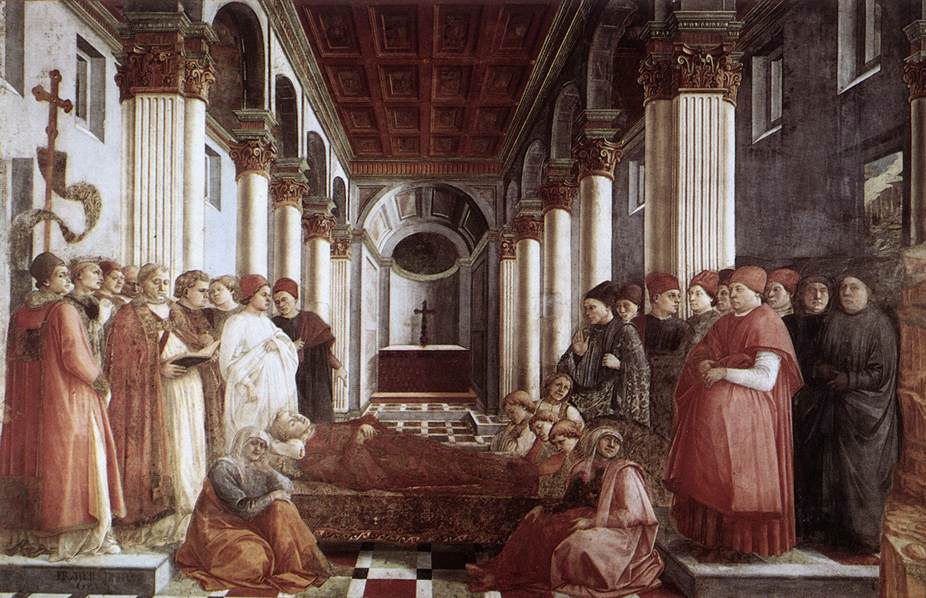
This painting is unmistakably a funeral. Death, in different cultures and to different people, means many things. It’s grief, sadness, loss, relief, longing, hope, despair. And if I had to say how this painting makes me feel, I would say something along the lines of, “drawn, leaned in, invested, somewhat curious.” Who is dead? Why are they dead?
Thanks to Pixar, one might think of emotions as discrete categories within us (hello, Anxiety from Inside Out 2), but in reality, it is a more complex process. People don’t detect emotions like sensors; instead, they construct them through inference, context, and prior experience. Essentially, there is no universal, “sadness face,” and this is evident across cultures. Schadenfreude, from German, meaning, “joy from another’s misfortune,” is a concept without an equivalent in other languages. Amae, the Japanese idea of, “pleasurable dependence,” has no parallel in English.
Looking back at Lippi’s painting, GPT-4 says I should feel, “calm.” The label dates back to the summer of 2025, when Taiwanese researchers created a dataset of 132,664 images called, “EmoArt” to train models to generate works for art therapy. The researchers knew that having dozens of psychologists annotate the entire dataset was not an option, so they had GPT-4 do it, and then claimed 91.47% human alignment for emotion labeling.
The Data
Source: “EmoArt,” 2025.
Visualization by: Nastassia Shaveika
According to the graph, 55.95% of all artworks are “calm.” If you are anything like me in museums, you know the feeling of a real connection to a piece of art; and that connection is never as simple as, “calm.” It usually runs deeper with reflection, soul-searching, and a little brain tingle.
To see if this was systematic, I ran a chi-square test. If emotions were shuffled at random, “calm” wouldn’t dominate. The test returned 449,027. With 132,664 artworks, a large chi-square is partly a function of sample size—the law of large numbers at work—but the pattern is unambiguous. The issue is systemic. Core affect theory maps emotions—in this case, 12 of them—onto two dimensions: valence (positive vs. negative) and arousal (energetic vs. not).
87.9% of artworks carry positive valence.
76.4% carry low arousal.
“Calm,” is exactly their intersection.
It is happy, but not too happy.
At this point, one might wonder if AI needs to be good at art. The answer is not really. But checking how these systems work is critical. When the media talks about AI risks, the conversation is about catastrophic and societal harms. I want to talk about the cultural ones.
First, these are the pillars of my work. Everything that follows is seen through them.
- Data Orientalism: an idea introduced by Dan Kotliar in 2020, building on Edward Said’s 1978 Orientalism.
- Data Feminism: concept from Catherine D’Ignazio and Lauren F. Klein, which comes from saying that data science is a form of power; it is distributed unfairly, and there are seven principles to battle this.
It probably will not surprise anyone reading this that AI is not good at recognizing emotions, especially from visual cues, and in something as abstract as a painting from 1460. Vision-language models don’t have an emotion module; they predict tokens based on visual pattern-matching against training data.
In this article, I am not going to have a big misclassifying reveal. Everybody can say, “Yeah, AI sees grief as happiness.” This would simply be a probability problem in the training. Here, I try to answer a more complicated question: Why and when AI chooses to see art as calm, and what that means for the constructed systems everybody lives in.
To identify potential predictors of an emotion label, I examined color, art styles, culture, and their combination.
Colors
Color on its own did not give any significant results. I extracted 95,515 color terms from the descriptions and ran Cramér’s V across all 144 possible color-emotion pairs, applying FDR correction for multiple comparisons. Ninety-three associations held. Red, yellow, and multicolor were linked to a few emotions—mainly, “excitement,” and had modestly significant associations.
Source: “EmoArt,” 2025.
Visualization by: Nastassia Shaveika
Color mattered, but it was not doing any of the heavy lifting. This is where “orientalism” returns. Edward Said characterized the “Orient” as a “mythical construct” that defines the West as superior, and the act of orientalism as a projection of the West onto the East. Ultimately, this is the mechanism the AI model uses. Taking western emotional categories and applying them to eastern art. “EmoArt” includes works from 56 styles. The West does not have 56 styles on its own. So I split the dataset by origin.
Source: “EmoArt,” 2025.
Visualization by: Nastassia Shaveika
If GPT-4 learned color-emotion associations primarily from western art, what happens when it encounters eastern art, where colors often carry different cultural meanings?
In the West, red is seen as the color of alert or passion. In Chinese culture, however, red carries celebration and good fortune. It is the color of weddings and the Lunar New Year, arguably the biggest holiday in many East Asian countries. Black, in western tradition, means mystery, or mourning, or fear – but in Japanese calligraphy, it is the color of mastery, discipline, and presence. Ink wash painting and calligraphy use only black Sumi ink to convey the full range of emotions, seasons, and atmospheres.
When I did the culture split, the pattern became clear.

Visualization by: Nastassia Shaveika
The model had learned seven times more color-emotion patterns from western traditions. The most popular colors got these numbers:
Source: “EmoArt,” 2025.
Visualization by: Nastassia Shaveika
The sample size imbalance partly explains the few associations; the model has seen so little non-western art that it cannot form proper associations.
Art Styles and Culture
When I zoomed in on the art styles, it became even more interesting. Chinese ink paintings, which feature landscapes, battle scenes, and political satire were “calm” 89.4% of the time and “excited” 0.2%.

Visualization by: Nastassia Shaveika
Meanwhile, the West showed a very different picture:

Visualization by: Nastassia Shaveika
To understand how spread out the emotions are across each movement, I calculated entropy: higher means a lot of variety, lower everything clusters into one of two labels. Western movements were at the top: Social Realism (1.89), Surrealism (1.73), Expressionism (1.68). Eastern traditions sat at the bottom: Chinese art (0.35), Gongbi (0.38), Korea (0.41), Shin-hanga (0.57).
An entropy of 0.35 for Chinese art pretty much translates to the model not doing any classification.
My Experiment
All of the above is based on “EmoArt,” annotated by a single model at scale with a very straightforward prompt. I decided to run my own experiment, with 23 artworks (balanced for regional representation, style diversity, and emotional range, picked by an algorithm and manually confirmed), using three companies and two prompts. I tested GPT-4 and GPT-5.1 from OpenAI, Claude Sonnet 4.5 and Claude Haiku 4.5 from Anthropic, and Gemini 2.5 Flash from Google.
Here is my first prompt for reference:
“Please analyze this artwork and identify the primary emotion it conveys. Choose ONE emotion from this list: [Frustrated, Annoyed, Alarmed, Aroused, Excited, Happy, Glad, Contentment, Calm, Tired, Bored, Sad]. Respond with only the emotion label.”
My second prompt specified, “Don’t default to ‘calm’ or ‘contentment’. Explain briefly why.”
Case 1. Tachisme, Western


Visualization by: Nastassia Shaveika
Sonnet 4.5 from Claude Anthropic said:
The large, heavy black shape is solid and immovable, suggesting a weighty, settled presence that is completely still… The flat, unmodulated green background is emotionally neutral and uniform. The overall effect is one of stability, composure, and profound quietude.
I have yet to experience “profound quietude,” but I’m glad AI is so hopeful that humans already feel this.
Case 2: Fauvism, Western


Visualization by: Nastassia Shaveika
For me, this painting isn’t just, “happy.” It’s joyful in a way that’s also energetic, spontaneous, and a bit wild. Is that happy or excited or glad? (I would choose “excited” because the brushwork felt more kinetic than peaceful, but, honestly, it could have been any of these.)
Case 3: Regionalism, Western


Five out of five said “tired,” while the “EmoArt” label was “excited.” The painting shows strong farmers harvesting wheat, but the context is important. 1930s America, Great Depression, unemployment. AI’s emotion results are missing community—people coming together in times of global uncertainty.

In the explanations, GPT-4 emphasized:
This mural-style painting brims with arousal, in the psychological sense of heightened activation, energy, and intensity—not sexual arousal, but a state of physical and emotional stimulation.
While Sonnet 4.5 by Claude Anthropic noticed:
The figures, despite their activity, overwhelmingly convey the state of being Tired or physically exhausted by their labor. Every figure is shown in a posture that emphasizes physical strain.
GPT-4, specifically with this painting, gave three different results: “Excited,” “Tired,” and “Aroused.”
Case 4: Baroque, Western

“The Virgin of the Apocalypse,” 1760.

You see a virgin emerging, but in the Baroque tradition, the facial expression shows peaceful acceptance. For me, it is about suffering and spiritual triumph, somehow, at the same time. AI models split on this, too.

Sonnet 4.5 from Claude Anthropic specified that it is a scene of “divine tranquility and heavenly peace.”
Case 5: Ukiyo-e, Eastern


The title translates from French as “The Wait.” The woman is waiting with a cigarette for people to come. Five models gave five different answers. Sonnet 4.5 from Claude Anthropic described this as “an Art Deco illustration depicting a figure in luxurious, ornate clothing”—misidentifying Ukiyo-e and still landing on different emotions.

Case 6: Chinese Ink Painting


I never really studied eastern art—I had one Xie He reading in college. But here, I can understand the lyrical turn the machines took. The painting features mountains emerging from mist, spare brushwork, and ample space. Traditional Chinese aesthetics would describe this as qiyun shengdong, meaning “spirit resonance and life motion.” But the 12 emotion list does not have this. So, if I had to pick, I would also choose “calm.”
Zooming out to see a bigger picture, every model labeled eastern art “calm” at higher rates than western art. Gemini shows the widest cultural gap, which is interesting given that it has the most multilingual encoders.
The results below are for Prompt 1, which did not ask for explanations.
Between the two prompts, Sonnet 4.5 from Claude Anthropic never reconsidered, while other models did.
Source: “EmoArt,” 2025.
Visualization by: Nastassia Shaveika
Haiku 4.5 from Gemini showed the widest range, with 12 unique emotions, while most models settled on nine or ten emotions. All models still favored positive emotions. For example, “happy,” “glad,” and “excited” appeared more frequently than negative ones like “sad,” “frustrated,” “annoyed,” and “alarmed.” The results below are shown for Prompt 1.
Source: “EmoArt,” 2025.
Visualization by: Nastassia Shaveika
Overall, these results show that the cultural bias and the “calm” default—while varied in severity—are present across all models. And prompt sensitivity is important. GPT-4 changed 11 of 23 labels when asked to reconsider—including dropping every “calm” label.
I suppose when AI is confused, it responds with “calm.” It remains emotionally neutral—the way humans say “interesting” when unsure what to say.
These results make sense, given that the most common training dataset, LAION-5B, found a similar skew toward western subjects and English-language descriptions; this is exactly what happened with “EmoArt,” too.
So What
This research is identity-heavy: it has a Taiwanese researcher-compiled dataset, annotated by an American engine using a western psychological framework. I should be transparent: When developing this piece of research, I used Claude, the same system that I am critiquing. And that’s the thing with AI deployment—you can’t fight it, but you should be really honest about it.
I started by saying that AI does not need to be good at culture, especially at understanding art; leave it to humans. But this is not a reason to neglect researching what is happening with AI, especially its deployment in contexts where misrecognition has consequences.
The Cleveland Museum of Art’s ArtLens “Express Yourself” interactive uses facial-recognition software to sort visitors’ expressions into fixed emotion labels—happy, surprised, fearful—precisely the kind of facial-emotion mapping that has been called into question.
The “calm” label might seem harmless at first, but biased classification systems are not.
This project is not a verdict on AI models. The most honest thing I can offer is an invitation to talk more about this. If you keep asking these questions, society can hold a mirror up to its own biases before they are automated. If you don’t, you’ll keep treating these models as oracles—and calling “calm,” whatever they tell you to call “calm.”
If you want to explore more, the full version is available here.

Nastassia Shaveika
Nastassia is a systems thinker and a data scientist on a quest to make data science transparent and caring. She previously conducted economics research and is now interested in making AI policy rigorous and inclusive. In her free time, she is a food and art traveler.


