
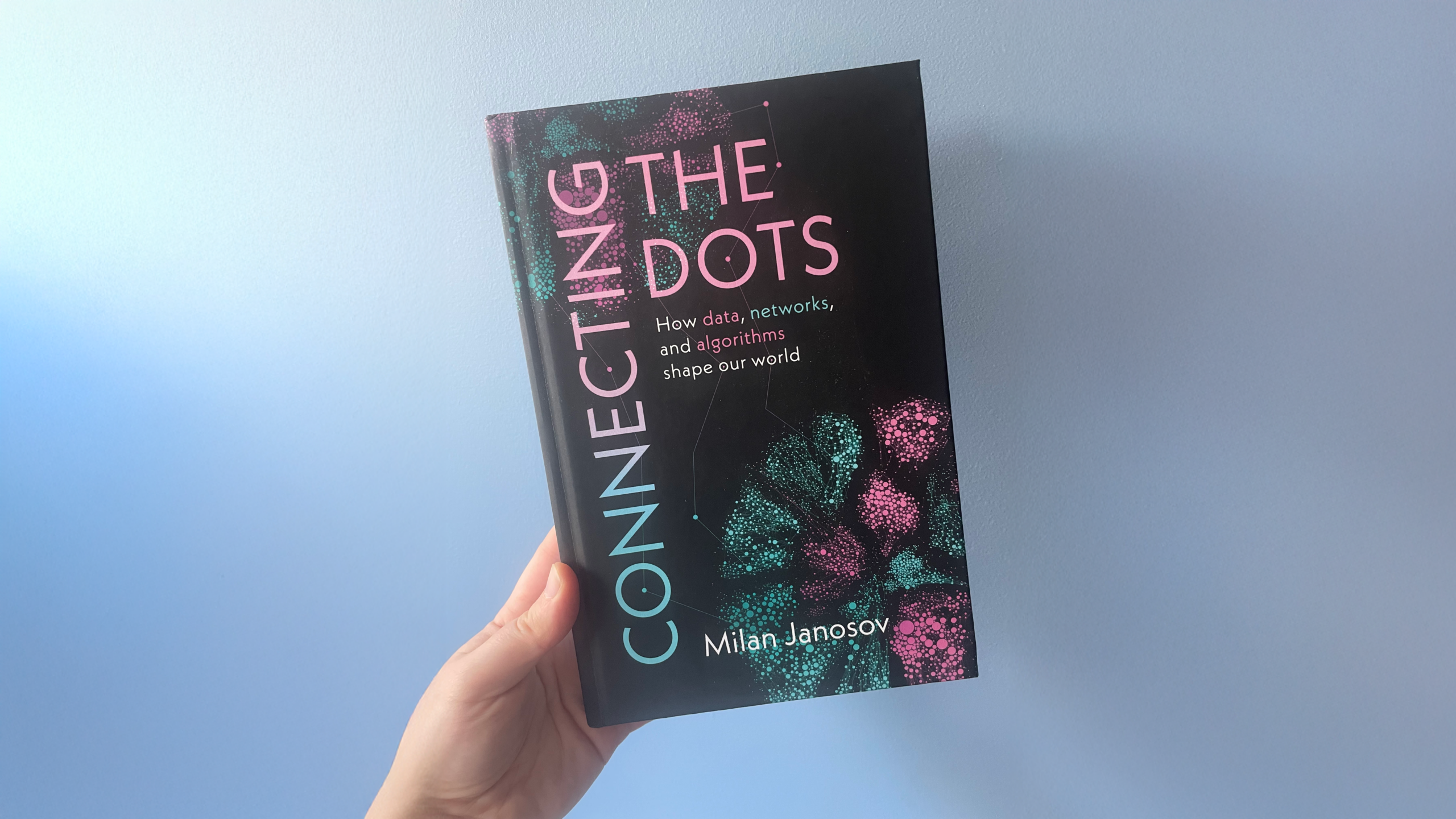
In our increasingly interconnected world, Connecting the Dots: How data, networks, and algorithms shape our world by Milan Janosov could not be any more poignant. Janosov walks readers through every level of networks, beginning with the individual and expanding out to different kinds of connections and what we can interpret from them. He assumes no prior knowledge from the reader and breathes life into network science with a light tone and culturally-relevant examples.
Connecting the Dots is organized into three sections: “Our Data Selves,” “Networks Coming to Life,” and “Hitting the Big Time, Network Style.” After a short introduction, “Our Data Selves” eases the reader into the concept of individual datafication via online profiles. Janosov discusses both social media profiles as well as online shopping profiles, breaking down what kinds of data might be collected, how that data can be stored both statically and dynamically, and where technology may be collecting additional data about us and attaching it to our profiles, even if we don’t explicitly answer a question or survey. He concludes with the example of targeted coupon distribution and use, showing how data aggregated from many users over time can help companies predict consumer behavior.
“Networks Coming to Life” expands the reader’s purview to understand how interconnected profiles create a network. This section of the book is where Janosov’s unique approach to choosing examples shines. Unpacking everything from Game of Thrones character deaths to NFT art markets and even DJ popularity, Janosov explains the anatomy of networks, with their nodes and different types of links, and how networks are born, grow, and sometimes collapse. He engages the reader in discussions of rather heady scientific concepts, like weighted and directional relationships and preferential attachment, but keeps his writing accessible by using familiar topics as the backdrop.
Finally, “Hitting the Big Time, Network Style” brings the first two parts together and applies network theory to the real world. Instead of just showing where networks exist, Janosov demonstrates the utility of these mathematical concepts in the real world. He discusses how network theory can help predict the spread of disease, increase workplace productivity, engineer successful social media campaigns, and more. The final chapter also touches on a particularly timely subject: artificial intelligence. This chapter unpacks some of the inner workings of AI and is followed by a conclusion where Janosov ties all three parts together, leaving the reader with the feeling that they’ve tackled the challenge of the book, which will help them better understand more complex discussions of network theory.
When I first started reading Connecting the Dots, Janosov’s light and often joking voice immediately set this book apart from other network theory books and articles. His voice, paired with examples that I recognized, like Game of Thrones, electronic music, and oddly specific online ads, made me want to keep reading, even when I didn’t immediately recognize some of the more network theory-specific concepts. In addition to well-placed examples, Janosov’s organization is experimentation-forward. He often explains how he devised the idea for a project or analysis before unpacking what he actually did, which made me more invested in knowing what he found.
While Janosov provides ample links to view his network projects throughout the book, I was slightly disappointed to discover that none of the diagrams were printed on the page. That said, Janosov does not stop at just linking his own work, but often mentions further reading throughout the chapters and provides a comprehensive list of references by chapter at the end of the book, making Connecting the Dots a network of information in and of itself.
By the time I finished Connecting the Dots, I felt that my grasp of network theory was greatly improved. I would absolutely recommend this book for anyone curious about behavior prediction, datafication, or network theory. Connecting the Dots has a low barrier to entry and easily sheds light on what is often a very confusing topic.
Learn more about Connecting the Dots and preorder it on its website.

Emilia Ruzicka is a data journalist, researcher, and editor who recently completed their M.A. in Media, Culture, and Technology at University of Virginia. They are currently pursuing freelance projects, including a blog and travel newsletter, while they search for their next full-time position. Outside of data viz, Emilia loves to visit museums, make art, and talk about the USPS. If you have a project proposal, story tips, or want to find out more, visit emiliaruzicka.com.
- Emilia Ruzicka

- Emilia Ruzicka

- Emilia Ruzicka

- Emilia Ruzicka


