
If someone were to ask you to think about artificial intelligence (AI), what comes to mind? A robot? A brain or circuit icon? Maybe a company logo or a specific model?
Now try to describe how it actually works. Do you picture something that reasons, learns, or understands? Or something closer to a very good guesser with no real understanding at all? How do you conceptualize the data used to train the model and its impact on how the model processes new information? How much of that picture comes from media, science fiction, popular culture, or overhyped claims, rather than the reality of how AI works? Laypeople often rely on folk theories to understand and explain complex systems. How much do these folk theories deviate from how AI functions? These questions motivated us to run workshops to understand people’s mental models (folk theories) of AI by asking them to create visual and physical artifacts (representations). In the following, we describe findings from our workshops and our hopes for the future.
In their work on AI literacy, researchers Duri Long and Brian Magerko pose five big questions: What is AI? What can it do? How does it work? How should it be used? And how do people perceive it? We zeroed in on the third. We drew on earlier research showing that visualizing or physically building a complex system helps people understand it, and on work about measuring how people picture AI, which can help them judge how far to trust it. From there, we built a workshop to capture how people imagine AI works. Our driving questions were: What are people’s mental models of how AI systems work, and how do AI literacy interventions shift these mental models?
Our AI literacy workshop
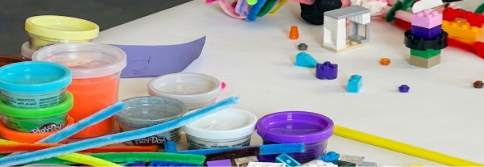
Since AI is a broad term and can apply to a variety of systems, our workshop activities focused on AI chatbots (like Anthropic’s Claude and OpenAI’s ChatGPT), given the rise in people interacting with them in everyday life. We used physicalization to elicit people’s mental models, in which participants created representations of chatbots using craft supplies like Play-Doh, Lego bricks, markers, and pipe cleaners. Asking participants to build a model of how chatbots work helped minimize their potential difficulty in verbally describing them, especially the fuzzy, abstract parts of how people think they work.
Workshops ranged from 90 minutes to two hours and included between six and 11 participants. We have run three workshops so far, each with a different group of participants: (1) academics during Love Data Week (Massachusetts), (2) community group volunteers (Massachusetts), and (3) K-12 educators and administrators (Maine). In each workshop, participants were put into small groups (three to four people), and after a brief overview of the goals of the workshop, each participant spent approximately 10 minutes creating an initial physical or visual representation (or both) of how they think an AI chatbot works. Each participant then described what they made and why. This first creation surfaced their existing mental models of chatbots before we introduced any new information or held group discussions.
We then provided two design probes in the style of data comics that included textual and visual information, in short, plain language, about how AI models are trained and where the data for training large language models used in chatbots comes from, allowing us to study any shifts in participants’ model representations. Groups then collaborated to update their shared representations based on what they had learned from each design probe. Each design probe took about five minutes to introduce, and groups had about 10 to 15 minutes to discuss each and produce an updated representation. The data comics and agenda are available on GitHub.
We analyzed the artifacts to extract visual metaphors and representations people used to describe chatbots and sorted them using a framework adapted from prior research. Here, we briefly describe our findings from the first workshop.
Beyond the black box
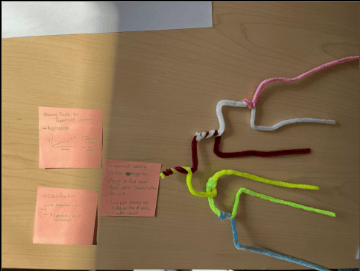
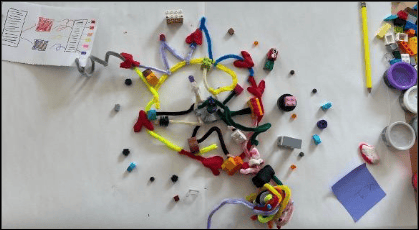
One of the earliest and most persistent metaphors for describing AI—one that has endured even as the technology has come to include a variety of methods—is the black box, and it surfaced in these representations too. In this common metaphor, AI’s function is inscrutable due to lack of expertise, lack of visibility into its workings, its complexity, or some combination. This black box can only be analyzed in terms of inputs and outputs. In our first workshop, four out of 11 participants included a black box as part of their models. Still, many used novel metaphors in their representations, including AI as a flower (with roots as data inputs and a flashy model output blooming at the center), as a maze (with many wrong turns as the user adjusts their prompt to get a useful answer), and as a factory (consuming resources like power, compute, and water and processing data to produce a final product).

In the workshop, the sheer variety of craft supplies proved useful, with many participants using pipe cleaners to represent process flows and Lego bricks or Play-Doh to represent inputs, outputs, and processing points. The mix of physical and visual representations produced by participants confirmed the utility of providing not just pencils and markers but also tactile materials to work with.
Notably, over half of the participants represented chatbots as an inherently cyclical process. Before the design probes, only two participants had included any human interaction or component in their models. Afterward, all three group representations incorporated humans and reflections on data access and infrastructural imbalances. Each group also identified a societal lever for addressing data disparities: regulation, education, and infrastructure. These discussions were unstructured; facilitators took notes and intervened only to ensure input from all participants.
Looking to the future
These workshops are only a first step toward designing unplugged activities that make reflecting on AI more accessible and low-tech. We are exploring more activities (e.g., envisioning utopian and dystopian futures) surrounding additional topics about AI and other hands-on mediums for interventions. We also plan to run these workshops with more diverse groups, particularly marginalized communities who are left out of conversations about how AI is designed and adopted.
More importantly, we want to empower those communities by handing the activity off to them directly. In the second workshop, we partnered with Joint Family and are now working with them and other similar nonprofits to circulate the workshop more broadly. That means treating the workshop protocol as a reusable, open-source toolkit, creating opportunities to co-design with communities so that other facilitators (e.g., educators and community organizers) can adopt these or similar workshops in their own contexts, adapt the materials, and surface understandings specific to their own participants.

Shani Spivak
Shani C. Spivak is a computer science PhD candidate at Northeastern University. Her human-computer interaction research focus lies at the intersection of AI ethics and governance, AI literacy and accessibility, and data visualization.

Shira Michel
Shira Michel is a computer science PhD candidate at Northeastern University. Her research centers the perspectives of users and communities to study human-AI interactions, particularly with challenges in trust and reliance. She is also passionate about empowering marginalized groups who have been excluded from or harmed by AI systems.


