
I design data experiences in the energy industry.
Most days, that means translating alarming trends: soaring demand forecasts and grid expansion curves: into something actionable. But data does not automatically become understanding. A number in a report remains a number; a chart in a slide deck is often nodded at and promptly forgotten. In my work, I have witnessed the “empathy gap” firsthand: the space between what the data says and what a human actually feels.
Working in San Francisco, I am also constantly exposed to wildfire data. Energy infrastructure and wildland fire risk are not separate problems; they share geography and causality. As our climate changes, we are seeing longer “burn windows” and more frequent extreme weather events. These are not just natural cycles. They are part of a feedback loop where our digital demand creates a physical burden on a warming planet.
As the grid expands to meet new demand, with AI data centers now consuming power at a pace that rivals entire nations, more lines run through terrain that is getting drier every season. I knew this connection. I could cite the statistics. What I could not do was make people feel the stakes of a simple AI prompt.
The Mentorship: From Theory to Spark
My background in Information Design and Data Visualization at Northeastern University taught me to treat data as a design material: something with texture and weight. However, I arrived at the Data Visualization Society (DVS) mentorship program with a specific challenge: How do you make someone feel the cost of something invisible?
My mentor, Divya Meghnani (Head of Product at Databricks), was instrumental in bridging the gap between my professional data world and my creative intent. He didn’t just support the technical build; he pushed me to move beyond the “what” of the data and into the “why” of the experience.
The Simulation: Wired to Burn
To solve this, I chose to move away from static charts and toward an emergent world. Inspired by Daniel Shiffman’s Nature of Code and the principles of Data Humanism pioneered by Giorgia Lupi, I turned to cellular automata.
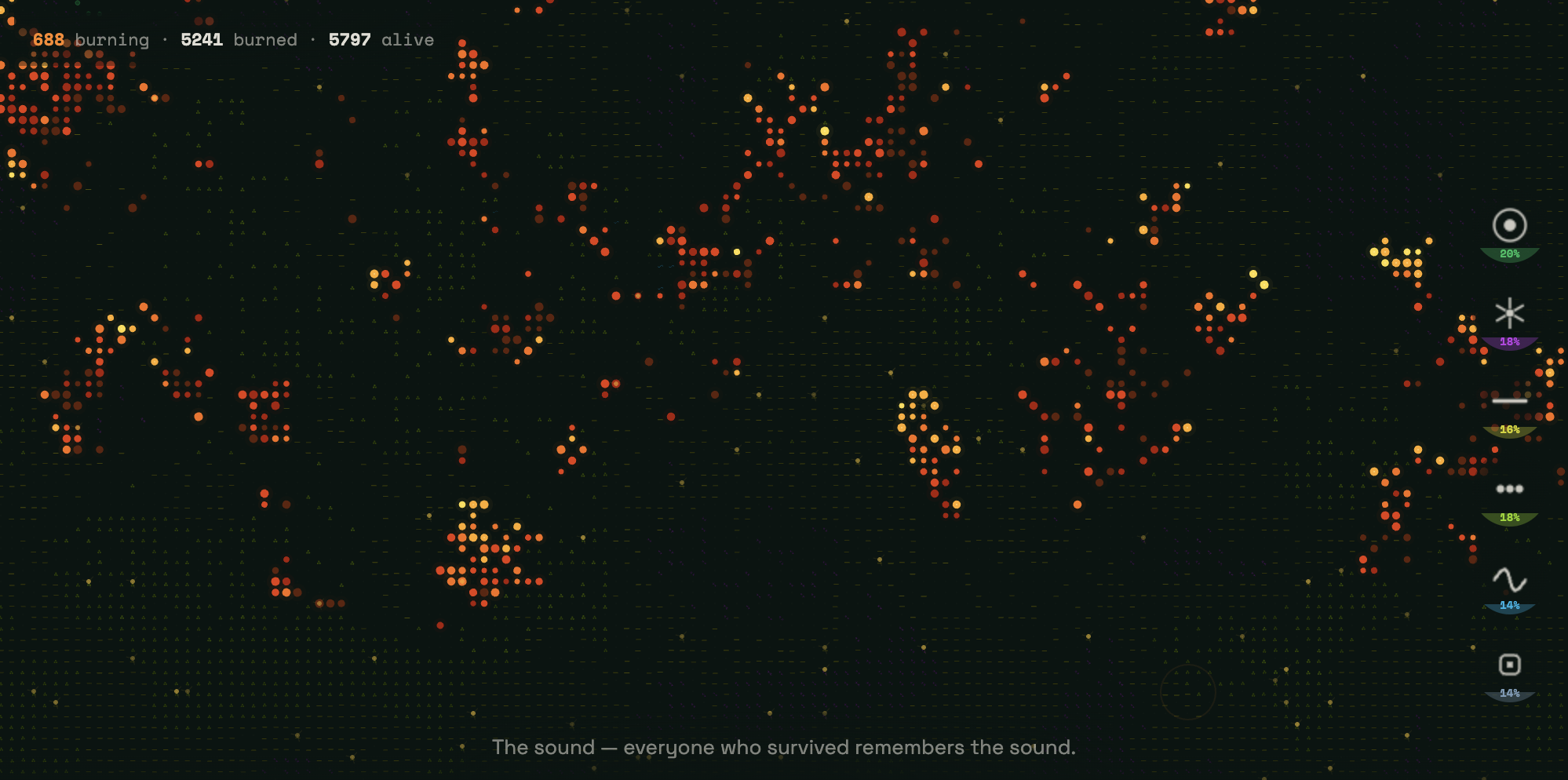
I built Wired to Burn, an interactive wildfire simulator where the user is not a passive observer. In this simulation, your cursor is the spark. You choose the terrain, ranging from dry grasslands to dense timber, and you set the conditions for ignition. But once you click, the “math” takes over.
The simulation runs on a grid where each cell’s state is determined by its neighbors and the environmental variables you have set. Using p5.js, I created a system where the fire behaves as a living system. It is a live calculation of risk that accounts for fuel density and “dryness” levels: variables directly influenced by the escalating energy demands of our AI-driven lives.
The simulation opens on a near-black canvas alive with six terrain types – each one a repeating symbol in vivid neon color against the dark ground. Emerald green targets for forest. Violet starbursts for shrubland. Acid yellow dashes for agriculture. Lime green dots for grassland. Cyan sine waves for wetland. Slate blue squares for developed land. An amber ember cursor hovers at center. The landscape is quiet. Nothing has burned yet.
As the fire moves through the 9,000+ cells, it leaves behind “ash.” Following Lupi’s philosophy that data should represent human stories, I did not want the burned ground to be just black pixels. Instead, as the fire moves, it leaves behind narration: text that appears in the wake of the destruction, explaining the hidden infrastructure costs of our digital behaviors.


The TIAT Exhibition: Making the Invisible Felt
When I presented Wired to Burn at the TIAT exhibition in San Francisco, I finally saw the empathy gap close.
I watched strangers walk up to the screen. At first, there was the visual awe of the generative fire. But as they read the text appearing in the ash, the realization shifted. They weren’t just playing with a simulation; they were looking at a mirror of our current climate reality.
One of the most powerful moments was seeing people go back and read the narration in the ash zones multiple times. It proved that when we give data a human pulse, people stop scrolling and start reflecting.
Conclusion: Evolving the Final Draft
I am a new voice in this community, transitioning from a student to an exhibitor in the span of a single mentorship. As I look toward this year’s Outlier Conference, I am thinking deeply about the theme of “The Final Draft.” To me, it represents the transformative power of curiosity, tools, and constraints. It is an acknowledgment of iteration and progress.
Wired to Burn has taught me that data visualization is never truly finished; it is constantly evolving. In the world of climate and energy, the terrain regenerates, the fire starts again, and the data keeps demanding to be felt.
Our job as data designers is not just to show the numbers. It is to remain humble in the face of these complex systems and ensure that when we talk about the world, we make the people in it feel exactly what is at stake.

Pranavi Aourpally
Pranavi Aourpally is a San Francisco–based creative technologist and data designer exploring the overlap of data, storytelling, and product. She currently designs at a data company while learning design engineering and building tools that make complex information feel human. Outside work, she experiments with personal data, small web projects, and collaborative visuals, and is especially interested in how everyday people use data to make sense of their own lives.
- Pranavi Aourpally


