
How the failure of a political data viz to circulate forced me to revisit the data it claimed to defend
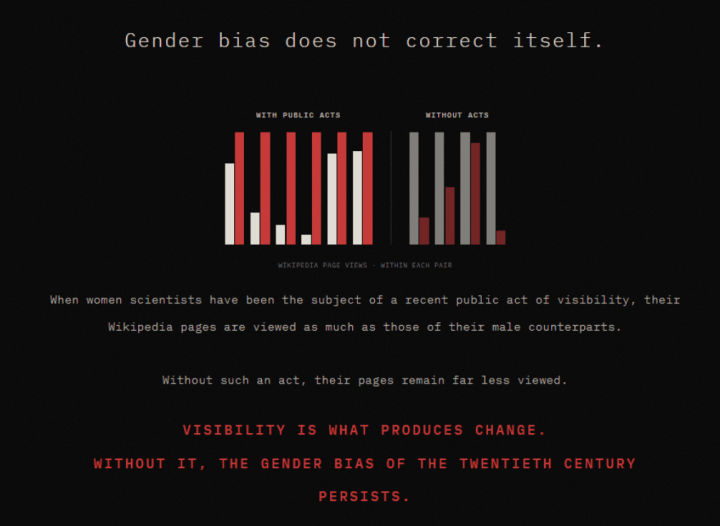
On February 11, 2025, I published my first data viz online, six days before it joined my installation “Guerrières” at the contemporary art center of my city, Clichy. The date was no accident: I wanted the piece to start circulating on social media before being confined to a gallery. The circulation never happened, and it is this failure that taught me what a digital object must do to extend a politically engaged work of contemporary art beyond its walls. The piece can be viewed at lauriane-mouysset.fr/a-sa-place/.
The installation and the digital piece designed to accompany it
I am a research director at the CNRS, working on the biodiversity crisis at the intersection of economics, ecology, and philosophy. I also serve as an ambassador for the French association Femmes & Sciences. As a young woman, I was able to choose a scientific path without ever having to question my gender, and that is precisely why I give my time to the association: so that a path free from stereotypes becomes possible for those who have not had that chance.
My desire to engage with the association took shape after a body of textile work produced in my studio, Mouysset Studio. Between 2022 and 2024, I had embroidered a series of portraits of overlooked women scientists—black-and-white photographs overlaid with colorful masks stitched directly onto the paper. It is this series, titled “Guerrières,” that would give rise to the digital piece.
In the autumn of 2024, I was offered the chance to exhibit some of these embroidered portraits at the Pavillon Vendôme, the contemporary art center in Clichy, as part of a group show running from February 17 to May 2, 2025. The exhibition coincided with my recent involvement with Femmes & Sciences, and I wanted to push the project beyond the visual gesture alone—to carry a message about gender stereotypes and the invisibility of women in science. So I embarked on my first data viz, without quite knowing where I was heading.
This data viz, which I titled “À sa place,” became my first publicly released digital object. In the gallery, it sat among the embroideries, accessed through a QR code placed between the pieces. Its function there was specific: to catch the attention of teenage visitors who might come to the exhibition but stay closed off to contemporary art, which they tend to see as not being for them. A QR code would resonate with their digital habits and their heavy phone use, and it would spark their curiosity. It would draw them into the work through the digital, and they would then look more carefully at the embroidered portraits—which they might otherwise have only glanced at.

A circulation that didn’t happen
The exhibition opened on February 17, 2025. Yet I put the digital object online earlier, on February 11—the International Day of Women and Girls in Science. This six-day gap was not calendar opportunism. Beyond the teenage audience I wanted to reach within the gallery, I wanted the data viz to circulate beyond the exhibition itself. An installation is bound to a place and a duration; a digital piece, by contrast, can keep circulating after closing day, reach people who will never come to Clichy, travel across social media, be passed around by email. Publishing on February 11 was a way to take advantage of a window when media attention was converging on the topic, and to seed that circulation.
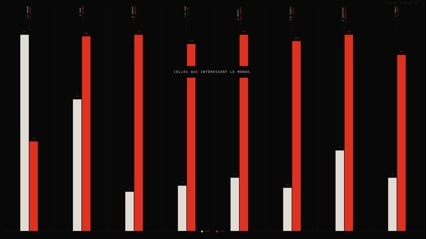
Between February 11 and 17, I received feedback from family, friends, and colleagues with whom I had shared the piece. It circulated, but only modestly, and only within activist circles already on board. At the opening on February 17, the diagnosis was confirmed. Several visitors said the same thing in different words: The piece was beautiful, but cryptic. It seemed to carry an important message, but its execution was too gallery, too art-world. In other words, people couldn’t see how to take hold of it. As it stood, the piece was losing in reach what it was gaining in elegance.
A thesis on clarity
I had designed “À sa place” within a contemporary art frame of mind, which made sense alongside the textile installation it was meant to extend. That frame values ellipsis, the implicit, the slow unfolding of meaning. It works in a gallery, in front of a viewer willing to give time to the work. It does not work for an object that has to circulate on social media, where reading time is measured in seconds, and where anything that cannot be immediately rephrased by the person sharing it never crosses the threshold of virality.
What this failure showed me was that a digital object attached to a politically engaged work of contemporary art, and meant to circulate, cannot simply extend the aesthetics of the installation. Graphic restraint remains compatible with circulation, because cutting what is not necessary makes for faster reading. What is not compatible is argumentative ellipsis—the practice of leaving the message implicit on the assumption that the viewer will reconstruct it. Standing before an exhibited work, the viewer will take the time to do so; on a social media feed, they will already have moved on.
A political digital object can be beautiful, but it must above all be clear—because clarity is what enables virality, and virality is what enables the political function the object is meant to serve. This realization led me into a redesign, not to simplify the piece, but to find a different point of balance: keeping the aesthetic dimension that was legitimate inside the installation, while clarifying the reach of the political message that defines its purpose.
When clarity forces a return to the data
The discipline of clarity required me to reopen the project on several fronts. To understand what was at stake in the redesign, it helps to look back at how the first version had been built.
I wanted something that would move the viewer without turning into a slogan. I had first imagined an animation in which the names of women scientists would fade over time, to show how history retains only the men. It was graphic, but it was staged: The erasure came from a narrative decision, not from the data. When I tried to ground the mechanism in a verifiable measure, I shifted to male-female pairs of scientific cosignatories. Wikipedia offered two publicly accessible metrics: the number of language versions of an article, which captures, to some extent, institutional memory; and the number of page views, which captures, to some extent, contemporary attention. By academic habit, I went with bar charts normalized within each pair, so that what should be compared was compared, without letting one pair of overwhelming notoriety drown out the rest. What I had first called “erasure” became, as the numbers spoke, something more like “compression”: These women exist, their pages exist, but they are squeezed, miniaturized next to their male colleagues.
The form sharpened around a discovery. As I cross-referenced the two metrics across an initial corpus of eight pairs, I saw that page views sometimes told a different story than the language versions did: For some women, contemporary attention had surpassed that of their male colleague, even as institutional memory remained dominated by the man. The data viz therefore had to tell the story in two movements: first what history has retained, then what the present is looking at. This first version implicitly suggested that men dominated in memory but that women had caught up in attention. That reading was both shallow and wrong—and it was while trying to make the piece readable that I realized it.
Reexamining the pairs one by one, I found that the recovery was not universal. Cecilia Payne’s page is now viewed nearly 12 times more than Henry Norris Russell’s; Jocelyn Bell Burnell’s nearly six times more than her PhD advisor Antony Hewish’s; Chien-Shiung Wu’s nearly 3.5 times more than Chen-Ning Yang’s. By contrast, the pages of Esther Lederberg, Marguerite Perey, and Marthe Gautier had shown no comparable movement.
What distinguished the first group from the second was something in recent public memory. The film Hidden Figures, released in 2016, had brought Katherine Johnson back to a wide audience. Bell Burnell had received the Breakthrough Prize in 2018. Cecilia Payne had her Google Doodle in 2019, Chien-Shiung Wu her US postal stamp in 2021, Rosalind Franklin the ESA rover in 2019. Six women had been the subject of a recent public act of visibility, including Lise Meitner, whose act—the chemical element meitnerium, named in 1997—is older than the others. Each of these acts corresponded to a surge in page views. The other women in the corpus had had no comparable act.
| Woman | Man | Recent public act of visibility | F/M ratio |
| Katherine Johnson | John Glenn | Hidden Figures (film, 2016) | × 1.2 |
| Jocelyn Bell Burnell | Antony Hewish | Breakthrough Prize (2018) | × 5.7 |
| Cecilia Payne | Henry Norris Russell | Google Doodle (2019) | × 11.6 |
| Chien-Shiung Wu | Chen-Ning Yang | US postal stamp (2021) | × 3.5 |
| Rosalind Franklin | James Watson | ESA rover (2019) | × 1.2 |
| Lise Meitner | Otto Hahn | Meitnerium (1997), 150th birthday (2023) | × 1.4 |
| No recent public act of visibility | |||
| Kathleen Lonsdale | John Desmond Bernal | none | × 0.9 |
| Marthe Gautier | Jérôme Lejeune | none | × 0.24 |
| Esther Lederberg | Joshua Lederberg | none | × 0.5 |
| Marguerite Perey | Glenn Seaborg | none | × 0.13 |
The case of Lise Meitner deserves a particular note. Her’s is a pair with a public act whose dominance is modest (× 1.4). This modesty is explained by the age of her act: the chemical element meitnerium, named in 1997, almost 20 years before the period of observation, and a quiet commemoration of her 150th birthday in 2023. This suggests that the freshness of an act matters as much as the act itself: The name of a chemical element nearly 30 years old does not carry the circulation force of a film, a stamp, or a Doodle. Meitner nevertheless stays in the with-act group, because an institutional act of visibility did take place and her pages do exceed those of her male colleague.
Across the 10 pairs retained in the final version, the pattern admits no exception: The six pairs with a recent public act of visibility produce six reversals, and the four pairs without such an act produce none. The thesis has changed in nature. The first version said that women were coming back. The new one says that the bias inherited from the twentieth century does not correct itself; it corrects itself only where a recent public act has taken place, and when it does, it does so in every observed case.
The move from the initial corpus to the final one involved two parallel decisions. I brought back cases I had originally set aside (Kathleen Lonsdale, Marguerite Perey), which turned out to be sharp examples of noncorrection in the absence of any visibility act. I also dropped three pairs that fell outside the comparison’s criteria. The case of Nettie Stevens was a false positive: An outlier peak in 2016 pulled the average up across the whole period, even though the man dominated year after year from 2017 onward. The case of Marietta Blau showed annual volumes too low to support a conclusion, between 3,000 and 9,000 page views per year. The case of Leona Woods, finally, showed an extreme ratio against Enrico Fermi (× 0.03) that was partly explained by Fermi’s major public fame as one of the emblematic figures of twentieth-century physics, which made the case poorly comparable to the rest of the corpus.
I also introduced an explicit distinction between two levels of evidence in the Method panel. The first gathers pairs whose undercrediting is the subject of substantial scholarly documentation: Margaret Rossiter’s work on the Matilda effect, Anne Sayre’s on the case of Rosalind Franklin, and the INSERM report on the Gautier-Lejeune case. The second gathers pairs whose undercrediting is observable in the data but lacks a dedicated scholarly source. This distinction lets the object claim its status: It is a piece of political data viz, not a research article. The requirement aligns with the line traced by Catherine D’Ignazio and Lauren Klein in Data Feminism, which approaches the practice of data viz through a feminist analysis of power relations in data.
Methodological note
Page views are annual totals for English-language Wikipedia articles, retrieved through the Wikimedia Pageviews Analysis API for the period July 2015–December 2025. The F/M ratio is the simple ratio of the woman’s average annual page views to the man’s; a value above 1 means the woman is viewed more than her male colleague. The number of language versions is taken from Wikidata sitelinks, verified in February 2026. Pair selection draws on the historical literature on documented twentieth-century cases of undercrediting, with priority given to pairs whose attribution dispute is supported by a scholarly source. Full data and code are available at lauriane-mouysset.fr/a-sa-place/.
In this way I came to see that the discipline of clarity does not merely clarify what one already has; it reveals what the first version had concealed beneath an elegance that stood in for argument.
The dramaturgy of a political data viz
The formal redesign went through 10 iterations between the first version and the final one. Three principles guided it.
The first was to tell the story in two movements. The new version opens on an aggregate view called “the system,” in which the 10 pairs appear gathered into two sharply contrasting distributions, with the women not yet named. The viewer sees the overall pattern before searching for its cause. A second movement, titled “the individuals,” then lights up each pair, revealing the names and the act of visibility (or its absence) for each woman. The sequence reproduces the cognitive path that led me to the pattern in the first place.
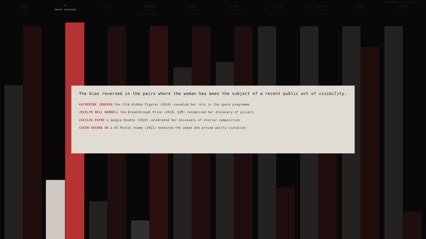
The second principle was to keep the graphic restraint, but to editorialize it. The first version aimed to be beautiful in the contemporary art sense. The new version aims to be readable in the scientific sense. The bar charts remain, because they are the most direct form for comparing two quantities without imposing an intrusive metaphor. What changes is their dramaturgy: They are revealed in sequence, with the names of the women they concern, and each subgroup is explicitly named for what it is.
The third principle was to name the acts rather than leave them implicit. The first version showed numbers; the new one names the gestures: Hidden Figures, Breakthrough Prize, Google Doodle, stamp, rover. These acts become concrete, datable, reproducible. The piece moves from observation to call to action, because it becomes clear that visibility is something one can do.
On the technical side, I worked in plain HTML, CSS, and JavaScript, without a framework, with the help of Claude, Anthropic’s AI assistant. The work took about 30 cumulative hours across several sessions. The integration of roles—the researcher who defines the thesis, the artist who shapes the form, the code that follows the editorial choices—is what makes the coherence possible. The new version recently replaced the first one on my website, and its reception remains to be seen.
In closing
A political data viz attached to a work of contemporary art is held in tension between two regimes. The regime of the work values ellipsis, the slowness of revelation, the elegance of a message left for the viewer to piece together. The regime of political digital media demands restraint, sequenced narration, explicit naming—because circulation is the condition of its function. The two regimes cannot be reconciled. One of them must give.
My experience suggests that it is the regime of the work that must yield, because the cost of yielding is lower: A clear data viz can still be beautiful, whereas a cryptic data viz stops being political. And the discipline that clarity imposes does not merely improve readability; it reveals what elegance had concealed. In the case of “À sa place,” it was clarity that brought out the pattern the first version had left in the dark, and that turned the object into a methodological tool for what comes next.
“À sa place” is the first piece in a series of hybrid textile-digital projects I am now actively developing. Each will follow the same discipline: an embroidered work that poses a question in the register of memory and emotion, and a digital component designed for the clarity that carries the work into civic circulation. It is in that tension between the two regimes that these hybrid objects are now searching for a grammar of their own.
I set out to rework the form. I ended up rethinking the data. Clarity, it turns out, is not a tool for communication. It is a tool for inquiry.

Lauriane Mouysset
Lauriane Mouysset is a research director at the The French National Centre for Scientific Research (French: Centre national de la recherche scientifique, or CNRS), working on the biodiversity crisis at the intersection of ecology, economics, and philosophy. She received the CNRS Bronze Medal in 2024 and was a 2024-2025 resident at the French Academy in Rome (Villa Medici). She is also a textile artist under the name Mouysset Studio, and an ambassador for the Femmes & Sciences national association in France. Author image captured by Corentin Fohlen.


