
Emojis are themselves a form of data visualization: a visual shorthand for expressing our feelings, reactions, and words through text messages and social media posts. But how much of this icon-based language is universal? How much is subject to generational differences? How much is based on personal meaning?
This was the central question of “mEMOirJIs,” a project I launched in the fall of 2024. Several recent studies had shined a light on the ambiguous nature of emoji use. A Preply survey identified the “most confusing emojis in every state,” with the Nail Polish emoji ranked first overall. Researchers at the University of Ottawa found that older adults struggled to interpret and use certain emojis. A CNN poll reinforced this generation gap, highlighting the tendency of Gen Z to use emojis more ironically than other generations do.
I read through these reports when they popped up in my newsfeeds, and I began to wonder if a data-art approach could illustrate this issue in a new way. Thus the “mEMOirJIs” project was born.
Collecting the Data
In planning this project, I first selected six emojis whose facial expressions had been panned for their miscommunication potential.

Next, in partnership with community and school groups throughout my hometown of Shreveport, Louisiana, I led a series of writing workshops that used these six emojis as the prompt for a six-word memoir, poem, or story. A six-word memoir is a form of micro-prose that seeks to distill an experience or emotion into just six words. An apocryphal story places Ernest Hemingway as the father of this genre; according to legend, when challenged to write a story in six words or fewer, he responded with “For sale: baby shoes, never worn.” I hoped the six-word prompt would feel accessible even to people who don’t consider themselves “real writers.” And this seemed to be the case; over and over again, people shared relatable, hilarious, and often contradictory responses to the six emojis. For example, in response to the Melting Face emoji, respondents wrote:
- “Music in, the world blocked out.”
- “I was told there’d be parking.”
- “Am I happy? I don’t know.”
- “Grace under pressure. Sinking in emotion.”
The generation gap was on full display both in the way respondents interpreted the emojis and in the specific stage-of-life circumstances they referenced. In response to the Loudly Crying Face emoji, a Gen Z respondent said, “I have never been so excited.” A millennial said, “Daycare dropoff: two sets of tears.” And a Gen Xer helpfully added, “Coping with cataracts? See a doctor.” Such six-word snippets brought the emojis to life, showcasing participants’ own voices in ways that quantitative survey data could never quite capture.
Visualizing the Data
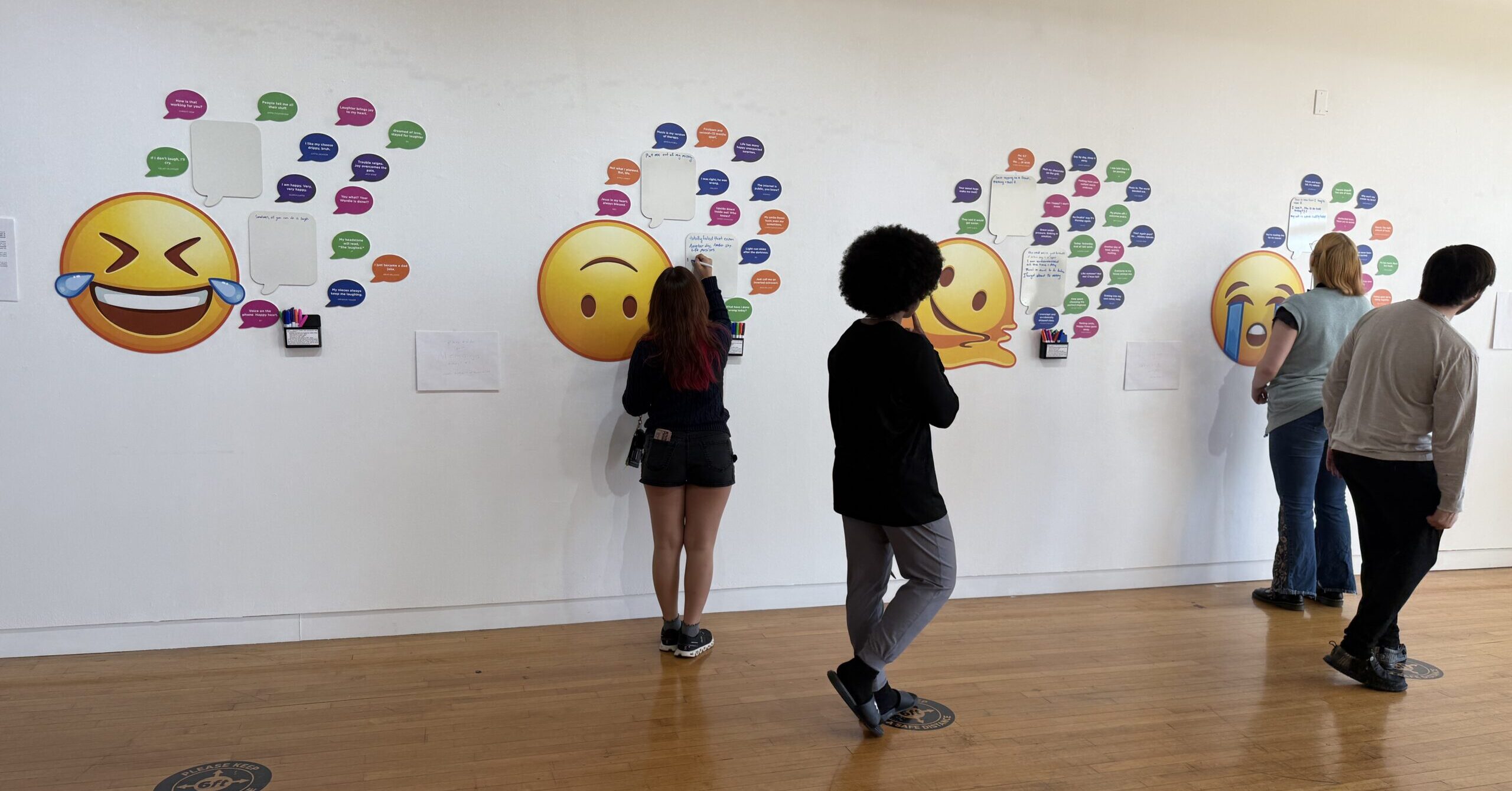
The “mEMOirJIs” project was displayed as part of a larger installation called “Data is Poetry”—which explored the intersections between data and literary arts—at Artspace Gallery in Shreveport, Louisiana. From the outset, I wanted visitors to be able to engage with the piece at three levels:
- Minimal engagement: Casual passersby could walk past the exhibition and easily see the emojis and enjoy reading a few of the memoirs that stood out to them.
- Medium engagement: Those who lingered at the exhibition could explore how emoji interpretation varied by generation.
- High engagement: Those who wanted to participate in the exhibition could add their own six-word memoir to the wall.
To construct the visualization, I worked with a local business to print giant versions of each emoji on 3 mm sheets of PVC (polyvinyl chloride). Because of space constraints and my desire to feature representative responses from each generation, I chose to display four of the six emojis in the installation itself, with 12 to 17 memoirs per emoji. I color-coded the memoirs by generation and printed each featured memoir on a PVC speech bubble. The final installation, therefore, appeared as though the emojis were “speaking” each of the memoirs. Finally, I added eight dry-erase speech bubbles to the wall, with markers that corresponded to the generations’ colors. Instructions told visitors to select their generation’s colored marker and add their own words to one of the dry-erase boards.

Reactions and Reflections
Several visitors told me that the big, familiar emoji images set a lighthearted tone and drew them into the larger installation. Those who had participated in the workshop series were delighted to find their own words on the wall, and the dry-erase boards seemed to be effective at promoting engagement. Visitors continued adding their own words to the piece throughout the two-month period that the installation was on display; however, they did not always abide by the “six-word” convention. I also noticed that visitors almost never used the erasers provided, preferring instead to squeeze their words into whatever space remained.
Some visitors shared that this piece made them reflect on their own emoji usage and the various ways in which technology can promote both connection and disconnection. This theme was amplified throughout the installation, supported by other data-art pieces that explored topics like screen time and information overload, artificial intelligence and creativity, and the collective experience of a modern solar eclipse.
And as for me? I’ll never see these emojis in quite the same way again. This project created a unique window into how community members express themselves, through both words and emojis. It served as yet another reminder that data can show up everywhere we look: in literature and art, in text messages and social media posts, in smiles and tears… and even in melting faces.

Callie Dean
Callie Dean is the director of applied research at the Institute for Nonprofit Administration and Research at LSU Shreveport. She is the author of the poetry chapbook Metadata (Bottlecap Press, 2025) and two forthcoming picture books: Marvelous Mistakes (Beaming Books, 2026) and Unstoppable Song (Lerner/Carolrhoda, 2027).


